
Back to the overview
Waiting is an unavoidable part of a healthcare visit. Whether it is an appointment with the GP, a treatment in the hospital or a check-up at the dentist: the waiting room is often the first physical space a patient enters. And that first impression matters. Scientific research increasingly shows that the design and lighting of a waiting room directly influence stress levels, perceived waiting time and even satisfaction with the care itself.
Yet in practice we still too often see the opposite of what works: bright lighting, neutral white walls and a clinical atmosphere that radiates little warmth. In this article we discuss what science says about lighting in waiting rooms and which solutions make the difference.
The waiting room as a stress factor is well documented. Neuroscientific research shows that in a fully human-built environment our brains produce higher stress levels than in a natural environment. That is exactly what makes the average waiting room so problematic: there is nothing natural about bare walls, distracting sounds and harsh lighting.
A systematic review published on ScienceDirect concluded that targeted interventions in waiting rooms, such as music, art and natural elements, can demonstrably reduce anxiety among patients. Interestingly, simulated nature, meaning photos and images of landscapes and cloudy skies, has almost the same calming effects as real plants or a window overlooking greenery. Anxiety reduction is also one of the strongest measurable effects of any contact with nature, simulated or not.
Research published in the scientific journal Buildings (MDPI) focused specifically on dental practices and reached a striking finding: patients prefer waiting rooms with soft ambient lighting over rooms with bright or directional lighting. The same study found that suspended ceilings with nature motifs, such as a cloudy sky or tree leaves, can significantly improve patient comfort and promote a connection with nature that has demonstrable therapeutic value.
The relationship between lighting and experience is not subtle. Harsh, cold lighting aggravates feelings of anxiety and creates a sterile, unwelcoming atmosphere. That is the opposite of what you want to achieve in a space where people already arrive tense.
Soft, diffuse lighting is demonstrably more calming. But it goes beyond intensity alone. Biodynamic lighting, lighting that imitates the course of the sun throughout the day, offers an extra dimension. A clinical study among 196 cardiology patients showed that a dynamic 24-hour lighting system, with bright light during the day and reduced light in the evening, was rated significantly better by both patients and healthcare staff than standard lighting. Patients also slept on average 29 minutes longer per night in the intervention rooms with this lighting compared to standard-lit rooms.
For waiting rooms the message is clear: choosing the right lighting is not an aesthetic luxury, but a functional intervention with measurable effects on well-being and experience.
Our DynamicDaylight LED panels are specially developed to achieve exactly this effect. They automatically adjust light color and intensity based on the time of day, from fresh morning light to a warm, calming glow at the end of the afternoon.
There is a reason why patients in studies consistently indicate that they prefer large windows overlooking greenery, or ceilings with nature motifs. The human brain responds deeply to visual signals of nature, even when that nature is not real.
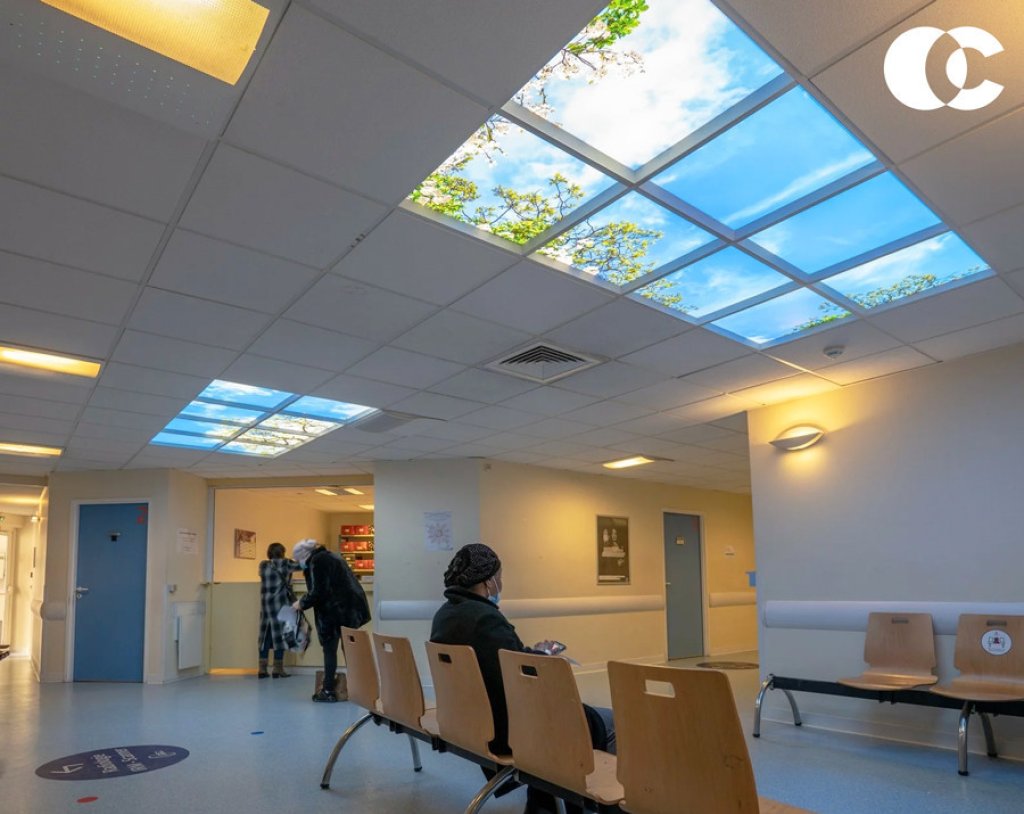
In a waiting room without windows or with limited daylight, an LED sky ceiling from OpenCeilings offers a direct and effective solution. The illuminated photo panels combine high-resolution images of cloudy skies, blossom or leaf canopies with daylight LED lighting. The result is a convincing sense of openness and space, exactly where people look up while they wait.
This is not a decorative addition. Research shows that including natural elements in the waiting room, including simulated nature imagery, shortens the perceived waiting time and increases the perceived quality of care. Patients who feel at ease in the waiting room enter the treatment room with a different mindset.
The OpenCeilings panels fit plug-and-play in a standard suspended ceiling of 60x60 or 120x60 cm. No renovation is needed, which keeps the threshold low for healthcare institutions.
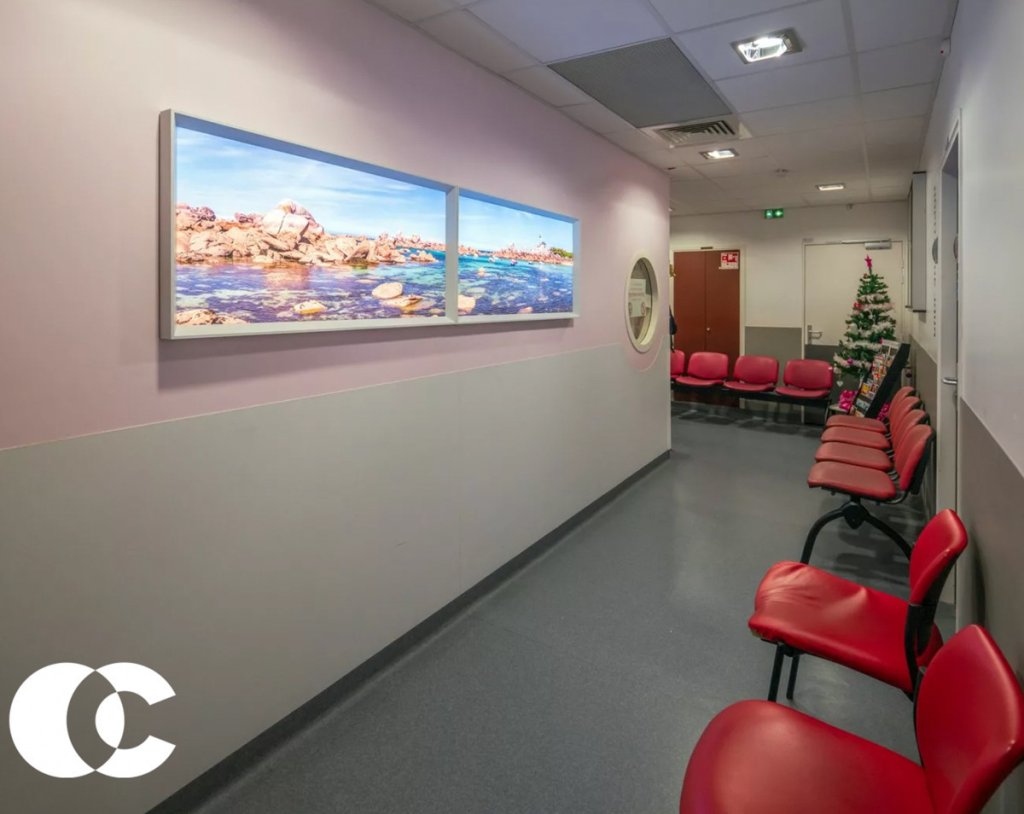
Not every waiting room has the luxury of windows with a view. Especially in interior healthcare environments, basements or converted office buildings, daylight is completely absent. For exactly those situations we developed the OpenWindows: illuminated photo panels that are mounted on the wall and create the illusion of a real window with a view of nature.
An OpenWindow combines high-resolution photography with LED lighting at the right color temperature and light intensity. The result is a calming view of, for example, a forest edge, a beach or a field of flowers, in a place where normally only a blank wall would stand. For patients and staff who spend hours in windowless spaces, this makes a noticeable difference. A virtual window is also a good complement to a photo ceiling.
Lighting in a waiting room is not something to think about afterwards. It is one of the most direct and proven ways to improve patient satisfaction, reduce anxiety and make a healthcare environment more human. The science is clear: soft, biodynamic lighting combined with nature imagery has a demonstrably positive effect on how people experience the waiting room and the care itself.
OpenCeilings offers healthcare institutions a practical and proven route to a better waiting room, without major renovations and with lasting results. View all healthcare applications on our healthcare page or request the free demo case and experience for yourself the difference that light and nature make.
Why is lighting in a waiting room so important? Lighting is one of the strongest stimuli in a space. Harsh or cold lighting increases stress and anxiety in patients, while soft, warm or biodynamic lighting demonstrably contributes to calm and a more positive experience of the care environment.
What is the difference between biodynamic lighting and regular LED lighting? Regular LED lighting gives a constant color and intensity throughout the day. Biodynamic lighting, also known as Human Centric Lighting, automatically adjusts color and brightness based on the time of day. This supports the natural day-night rhythm of people, which has measurable effects on well-being, concentration and sleep quality.
Can a sky ceiling be installed in an existing waiting room? Yes. The photo panels from OpenCeilings are designed to fit seamlessly in a standard suspended ceiling, in the common sizes of 60x60 and 120x60 cm. Installation is plug-and-play and requires no major renovation, so the space can be transformed quickly and with minimal disruption.