
Back to the overview
Hardly anyone enjoys time in a waiting room. Patients arrive with questions, pain or worry, while visitors sit waiting for news. Those feelings travel with them into the consulting room. A space that feels calm often makes the conversation that follows a little easier, for the patient and for the clinician alike.
Waiting also feels longer when there is nothing to rest your attention on. A glance at the clock, a pile of dated magazines, harsh strip lighting overhead: together they tend to feed the restlessness. That is why good waiting room design looks beyond chairs and walking routes and includes positive distraction. These are elements that hold attention in a pleasant way and give busy minds a moment to settle.
People generally feel better in surroundings that remind them of the outdoors. This principle, known as biophilic design, is being studied more and more in healthcare buildings. In one study of hospital waiting areas, participants clearly preferred spaces with views of nature and plenty of transparency. Daylight, a sense of warmth and natural materials were also linked to how appealing people found a waiting area.
Interestingly, the nature does not have to be real. In a Czech pilot study with 117 patients in an oncology waiting room, people who watched footage of forests or the sea showed a better mood and lower arousal. Patients who watched the news or saw nothing at all showed no such change. The researchers see this as a promising way to bring nature to people who cannot get outside themselves (Frontiers in Psychology, 2024).
As autumn sets in, this matters even more. During cold and flu season, waiting rooms fill up, the days get shorter and little daylight comes through the windows. Many waiting areas also sit deep inside a building with no window at all.
Start with the lighting. Bright, cool and uniform light quickly feels clinical. With biodynamic lighting such as DynamicDaylight, the light follows the course of a real day, from fresh and bright in the morning to warmer and softer in the late afternoon. This supports the circadian rhythm of patients and of staff, who spend the whole day there.
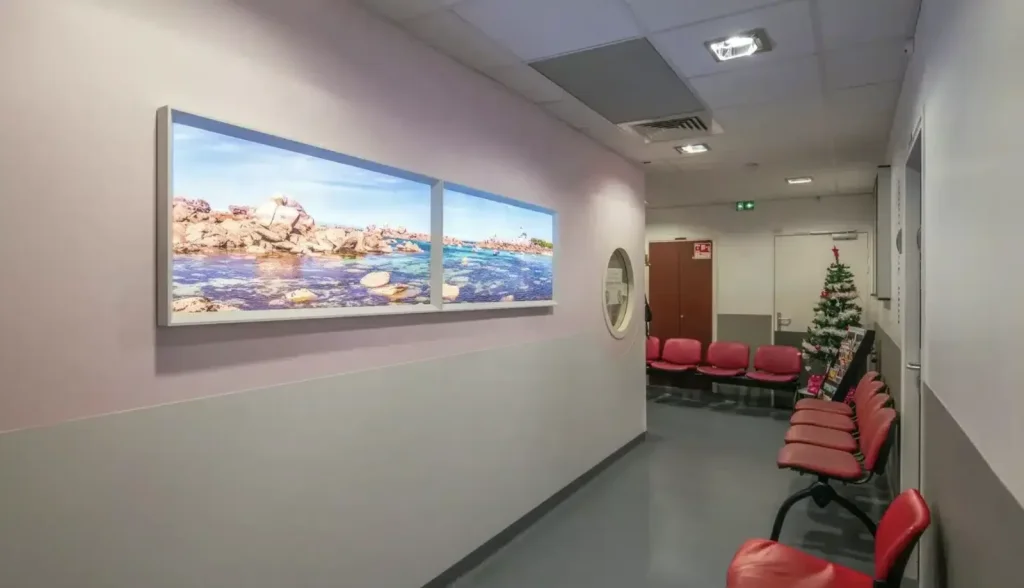
Next, look up at the ceiling. People in a waiting room often gaze upwards or at a blank wall. An OpenCeilings LED sky ceiling turns that view into an opening to the sky: a blue horizon, drifting clouds or a canopy of leaves. On the wall, a virtual window works in the same way. With OpenWindows, a windowless room still gets a view of nature.
Combine this with the basics of a good waiting area. Think comfortable seating arranged in small groups rather than rigid rows, plants, acoustic treatment and clear signage. Together they create a space that feels restful without becoming a burden to maintain.
A beautiful waiting room should never make life harder for the team. Our photo panels are plug and play and fit into a standard suspended ceiling, so a practice or ward does not need to close for long. The LED lighting is energy efficient, lasts for years and needs very little maintenance. From our range of designs you can pick an image that suits your patients, from tranquil skies for adults to cheerful branches with birds for a children's ward.
Thoughtful waiting room design gives patients and visitors a sense of care before the first conversation has even started. Nature imagery, pleasant light and a considered layout all help to ease tension and make waiting easier to bear. OpenCeilings has spent years helping hospitals, GP surgeries and clinics create exactly that kind of environment.
Curious how a sky ceiling would look in your own waiting area? Order our demo case or get in touch with us for personal advice, and explore our LED sky ceilings. You will find more inspiration on our healthcare page.
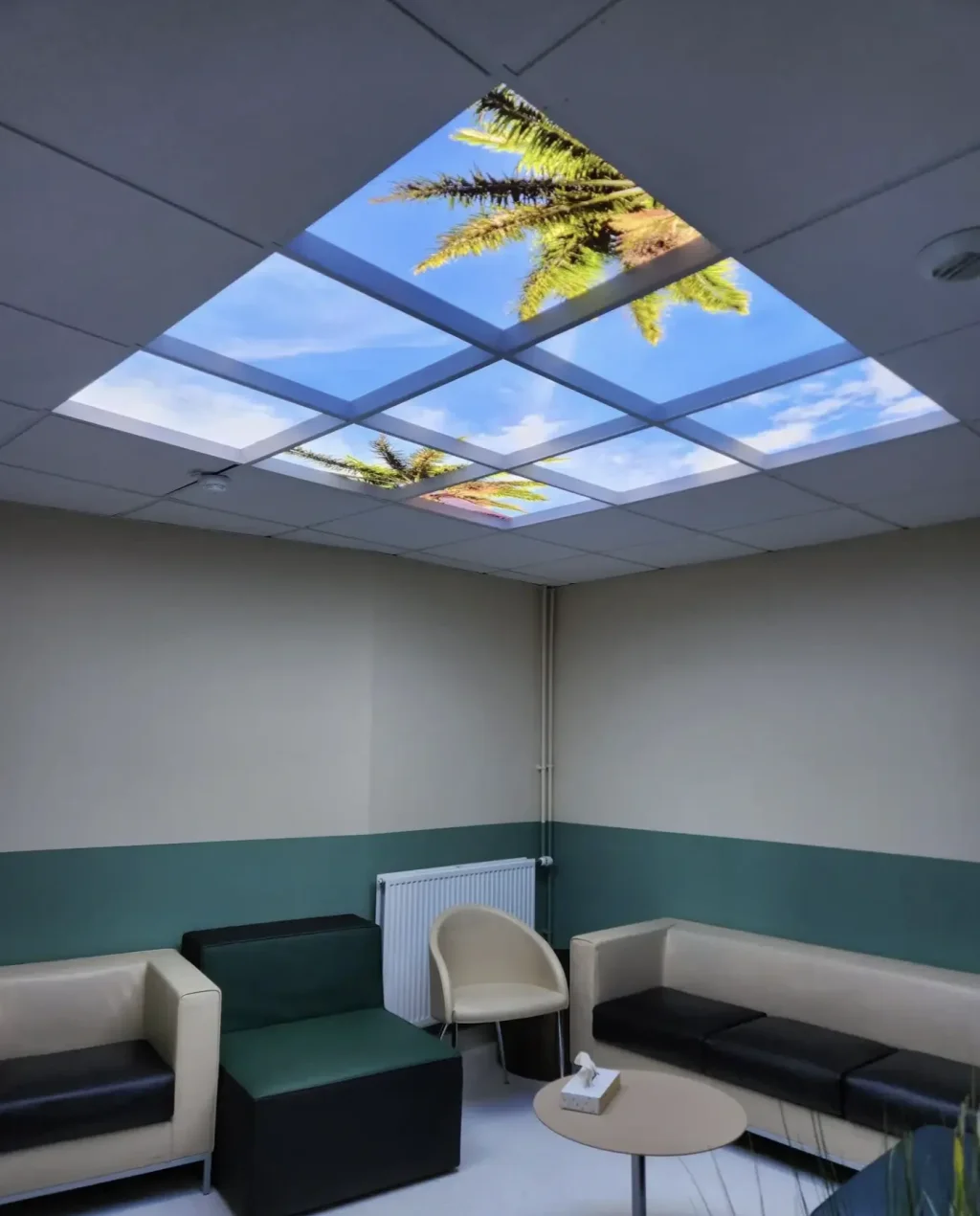
A calming waiting room brings together soft, natural feeling light, comfortable seating, low noise levels and elements that hold attention in a pleasant way. Nature imagery, plants and a view of the sky all play an important part.
Yes. OpenCeilings panels fit most standard suspended ceilings and simply replace one or more existing ceiling tiles. There is no need for a full refurbishment.
Real nature remains valuable, but research shows that images of nature can also lift people's mood. Particularly in rooms without windows, a photo ceiling or virtual window is a realistic alternative.