Back to the overview
Healthcare work has its own rhythm: bleeps, handovers and a rota that never quite adds up. Stress builds over the course of a shift, and a break is often the only chance to step away for a moment. That moment is short, so the setting of those minutes makes a real difference to staff wellbeing.
Yet in many buildings, staff rest areas get whatever space is left over. An inner room with no windows, harsh fluorescent tubes, a humming fridge and a table covered in paperwork. You sit there, but you never quite switch off. In winter this becomes even more obvious: if you start at seven and leave after five, you barely see daylight on a working day.
Research confirms what many nurses feel instinctively. In a study of restorative design features for hospital staff break areas (Nejati et al., 2016), healthcare staff expressed a strong preference for access to nature, daylight and fresh air. A view of the outdoors gave them a sense of distance from work: a brief escape from stress and fatigue.
A good nurse break room strikes a balance between two needs. Staff want to stay close to their ward, so they can return quickly if needed. At the same time, they need privacy and some mental distance. A rest area in the middle of a corridor, with a clear view of the call board, only does half the job.
Light plays a major role in staff rest areas too. Our body clock responds to the colour and intensity of light throughout the day. Cool, bright light in the morning helps us stay alert, while warmer light later on supports relaxation. For night shifts this matters even more: harsh bluish white light at three in the morning is the last thing your body needs.
And then there is nature. The idea behind biophilic design is simple: people recover more quickly when they feel connected to natural elements. Even where a real view is missing, a convincing image of nature can help the brain shift gear. That is how a plain room becomes a genuine restorative space. We see this need across all our healthcare projects.
Mount Sinai Hospital in New York showed that simulated nature can have a real effect. During the pandemic peak, the team created so called Recharge Rooms with projected nature scenes, nature sounds, dimmed lighting and scents. After a fifteen minute session, the perceived stress of healthcare workers fell by almost 60 per cent on average, according to their study (Putrino et al., 2020). It is a short term effect, but for a break, that is precisely the point.
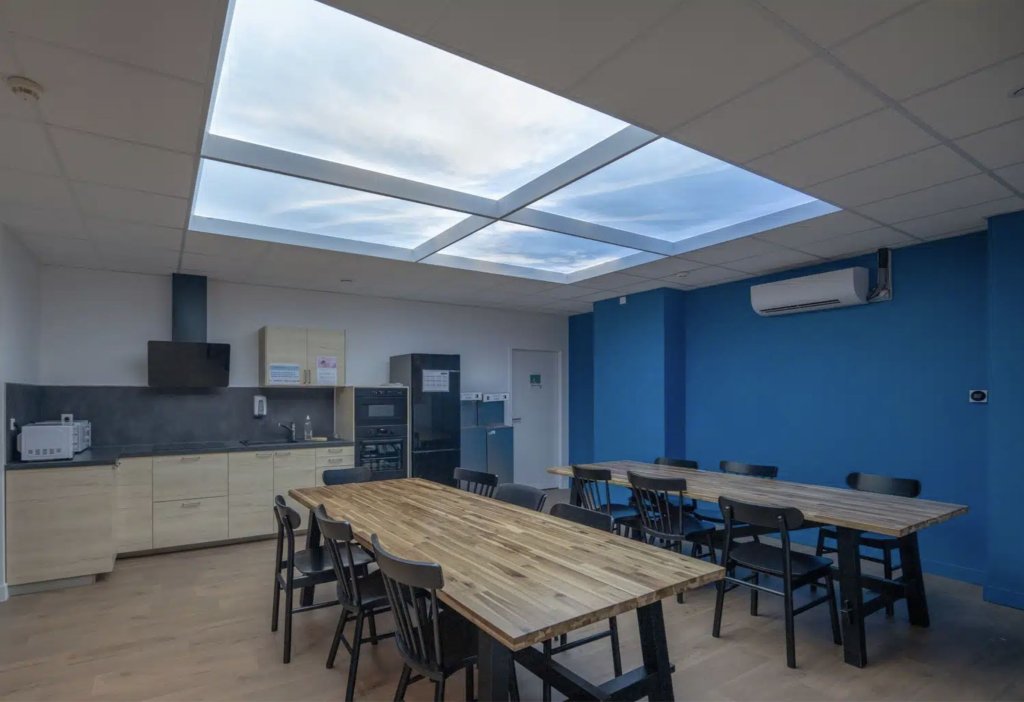
At OpenCeilings, we translate that principle into a permanent solution. An LED sky ceiling from OpenCeilings brings a realistic, evenly lit sky into staff rest areas. Where there is no window, a virtual window such as OpenWindows opens a view onto a forest, dunes or a mountain lake. Suddenly an inner room feels spacious and connected to the outdoors.
Combine this with biodynamic lighting from DynamicDaylight and the light in the room follows the natural course of the day. Fresh and bright during the day, warmer and softer in the evening and at night. This way, staff rest areas support the circadian rhythm of people on every shift, including those working nights.
In practice, a small intervention is often enough: a single photo panel or one virtual window can transform staff rest areas completely.
Healthcare staff spend all day looking after others. Staff rest areas that offer daylight, nature and calm give something back. Our panels are plug and play, fit into a standard suspended ceiling, are energy efficient and need very little maintenance. That makes the step from coffee corner to place of recovery smaller than many organisations expect. Curious what this could look like in your setting? Discover how our LED sky ceilings open up a windowless room, or request a demo case and experience the effect for yourself.
Yes. OpenCeilings panels fit into a standard suspended ceiling grid. You simply replace one or more ceiling tiles, with no building work required.
Research shows that nature imagery, dimmed lighting and natural sounds can noticeably lower the perceived stress of healthcare workers in the short term. It is no substitute for good workforce policy, but a valuable addition.
With DynamicDaylight, the colour temperature adapts to the time of day. At night the light becomes warmer and softer, so staff can unwind without further disrupting their body clock.