
Back to the overview
Delirium is a sudden disturbance of attention and awareness. Patients become confused, lose track of where they are or see things that are not there. It is common among older people, after surgery and in intensive care. For patients and their families it is frightening, and for clinical staff it adds a considerable extra workload.
Delirium is also often linked to longer hospital stays and slower recovery. The causes are usually multiple: illness, medication, dehydration, pain and lack of sleep reinforce one another. That is why hospitals are not looking for a single miracle cure, but for a combination of measures. And that is exactly where the physical environment comes in.
Anyone working on delirium prevention soon looks at the sleep-wake cycle. Our body clock needs clear signals: bright light during the day, darkness and rest at night. In a hospital room those signals fade. The lighting stays the same all day, equipment beeps through the night and sometimes there is no window at all.
The value of a broad approach has been known for a long time. The study by Inouye and colleagues showed back in 1999 that a programme with several components, including tackling sleep deprivation, immobility and disorientation, led to markedly less delirium in older patients. The NICE guideline likewise lists appropriate lighting, a clearly visible clock and good sleep hygiene as part of prevention.
To be fair, light on its own is no guarantee. Studies that look only at light therapy show mixed results. As part of a wider approach, however, a recognisable lighting rhythm does help patients stay oriented and sleep better. In that way the room itself contributes to delirium prevention, alongside the work of the care team.
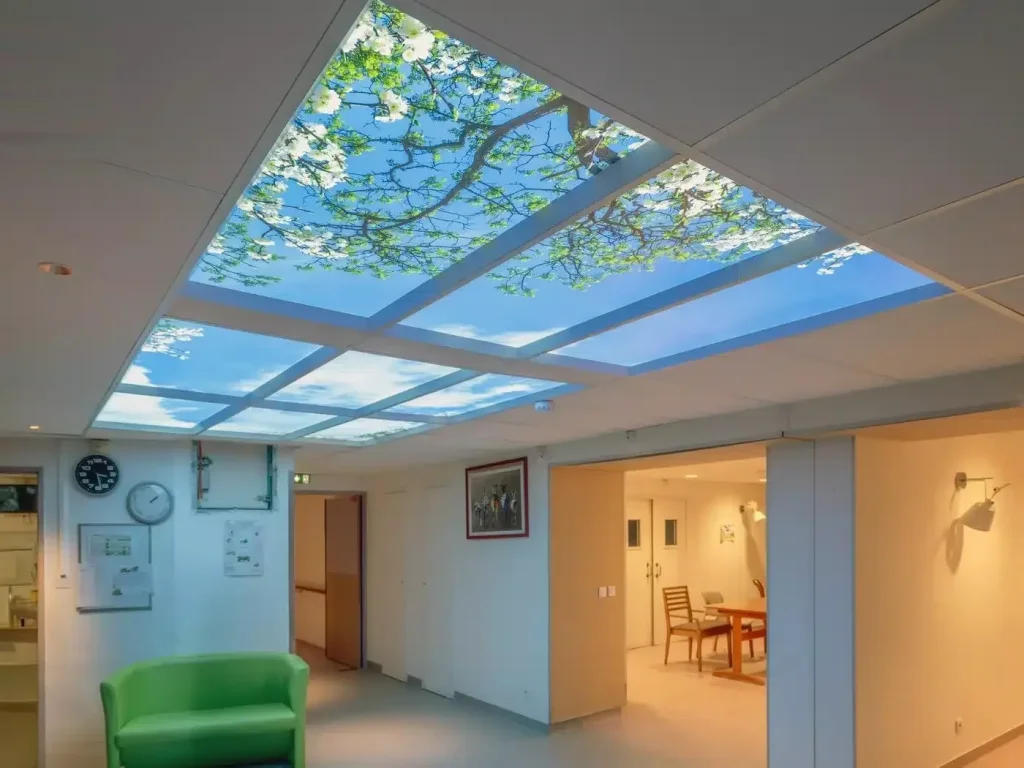
This is where circadian lighting shows its strength. With DynamicDaylight, the light in a room follows the natural course of the day. Cool and bright in the morning to help people wake up, steady in the afternoon, and warmer and dimmer towards evening so the body can prepare for the night. This gives a patient's circadian rhythm something to hold on to again, even when the winter days outside are short and grey.
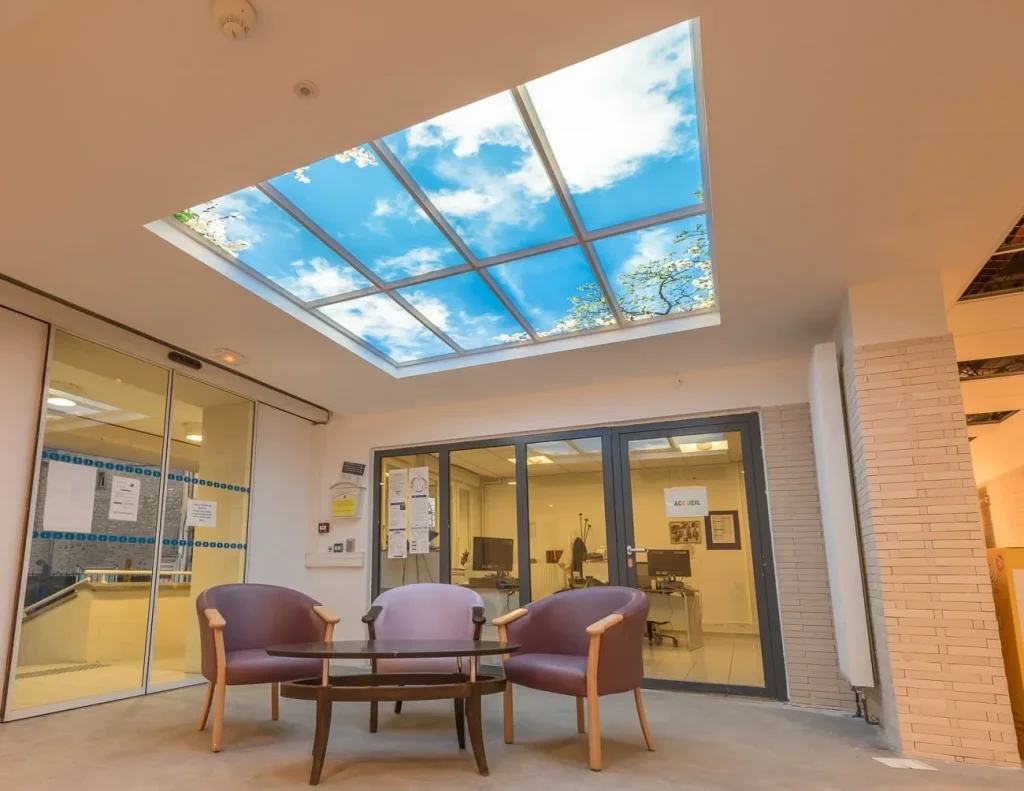
Experience matters too. A plain ceiling tile is often the only view a bedbound patient has. A sky ceiling with a realistic sky turns that ceiling into a calming image and a sense of connection with the outdoors. Where there is no window, a virtual window from OpenWindows brings a natural view inside. Calm and orientation are precisely what a confused patient needs.
For healthcare facilities, any solution has to be simple to fit in. Our panels are plug and play and fit into a standard suspended ceiling without major building work. The LED technology is energy efficient, long lasting and needs very little maintenance. That makes it realistic to upgrade an ICU bay, a geriatric ward or a recovery room step by step.
Delirium prevention is teamwork. Nurses, doctors and families do the most important work: getting patients moving, reorienting them, managing pain and protecting their night's sleep. The room can either support that work or get in its way. A room with a clear day and night rhythm, calming imagery and fewer stimuli at night is therefore a logical link in any delirium protocol.
At OpenCeilings we believe a healing environment does not have to be large or complicated to make a difference. We are happy to help you work out which rooms would benefit most from better light. Explore our solutions for healthcare, or request our demo case and see for yourself how biodynamic lighting transforms a patient room. Would you rather talk it through first? Feel free to get in touch with us.
Light is not a treatment in itself. A clear rhythm of bright light by day and darkness at night does support sleep and orientation, and guidelines include appropriate lighting as part of a broader approach to delirium prevention.
Above all, spaces where patients stay for long periods and see little daylight, such as intensive care units, recovery rooms, geriatric wards and windowless rooms.
No. OpenCeilings panels fit into a standard suspended ceiling and install plug and play, so the ward can keep running as normal.