
Back to the overview
Light is much more than the ability to see. Our body uses daylight as the primary time cue for a huge number of biological processes. The suprachiasmatic nucleus in our brain acts as an internal clock, but it needs daily light input to stay properly calibrated. Without that input, our circadian rhythms are disrupted, with direct consequences for sleep, hormone balance, mood and cognition.
The chemistry behind this process is now well understood. Blue light at wavelengths around 480 nanometres suppresses the production of the sleep hormone melatonin and stimulates the production of serotonin, the hormone that gives us alertness and a positive feeling. In the evening, when daylight becomes warmer and less intense, melatonin production rises and the body prepares for sleep. In a windowless room, this natural pattern is missing completely.
Research published in the Journal of Clinical Sleep Medicine shows that office workers without access to window light sleep on average 46 minutes less per night and score lower on quality of life than colleagues with a window workstation. That lack of sleep translates during the day into reduced concentration, slower decision-making and higher error rates. For organisations, a lack of daylight is therefore not only a wellbeing issue but also a productivity issue.
Disrupted biorhythm: the circadian rhythm is thrown off balance, with sleep problems as a direct result
Higher stress levels: higher cortisol levels during the day and a feeling of alertness that never subsides
Mood problems: increased risk of Seasonal Affective Disorder (SAD) and mild depressive symptoms
Reduced cognition: poorer concentration, slower reaction time and more mistakes
Eye strain: static artificial light without variation tires the eye muscles faster
Reduced wellbeing: lower job satisfaction and a higher risk of sick leave
Did you know? People spend on average 90% of their time indoors. In windowless workspaces this rises to 100% of working time. For a large group of professionals, the impact of a lack of daylight is therefore a daily reality.
Daylight simulation is the technology in which artificial light sources imitate the spectrum, intensity and course of natural daylight. The term covers a broad range of solutions: from simple "daylight" fluorescent tubes to advanced biodynamic LED lighting systems that change automatically throughout the day.
The most effective systems do more than produce white light. They vary continuously in two dimensions: the colour temperature (measured in Kelvin) and the light intensity (measured in lux). In the morning, cool white light is emitted at a higher intensity, similar to the fresh morning light we experience outdoors. During the afternoon the tone shifts to neutral white, and in the evening to a warm amber, comparable to the light of the setting sun.
This dynamic pattern speaks directly to what scientists call circadian lighting: lighting that is aligned with our 24-hour rhythm. Studies show that people who work under circadian lighting sleep better, score higher on daytime alertness measurements and feel more positive about their work environment.
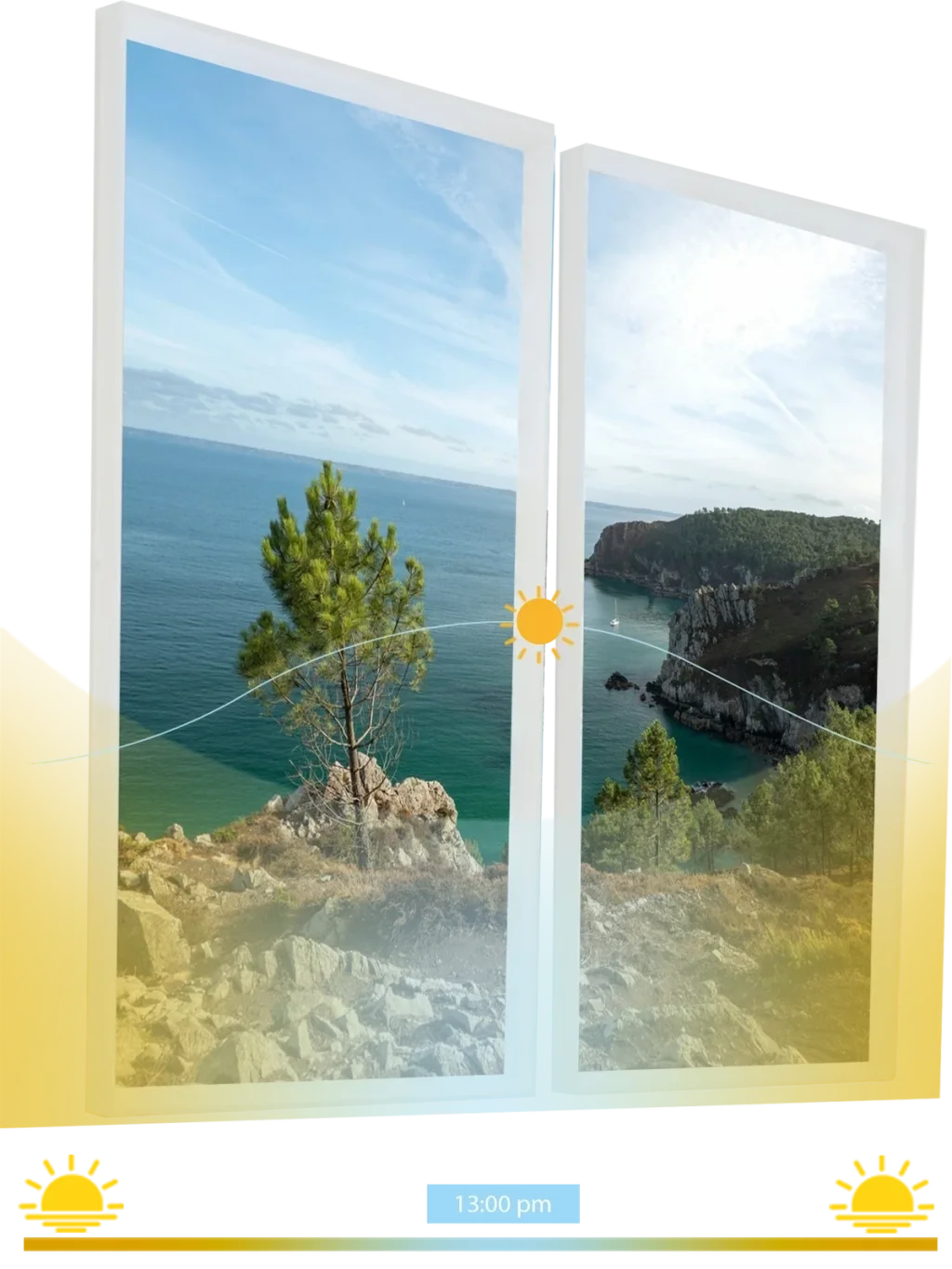
Standard LED panels deliver a static light: the same colour temperature and the same brightness all day. They are functional, but give our brain no time signals. Good daylight LED lighting works differently: the spectral composition changes continuously, just like outdoors. In addition, high-quality daylight lighting has a high Color Rendering Index (CRI) of 90 or higher, so colours look natural and vivid instead of flat and desaturated.
Another difference lies in the light distribution. Well-designed LED daylight systems produce flicker-free, evenly distributed light without harsh shadows or overexposed spots. This reduces eye strain and makes long working sessions more pleasant. The combination of dynamic colour temperature, high CRI and even distribution is what sets daylight simulation systems such as the DynamicDaylight LED panels from OpenCeilings apart from ordinary ceiling lighting.
There is no single universal solution for a lack of daylight in windowless spaces. The best approach depends on the type of room, the users, the budget and the level of immersion you want. We discuss the most relevant options, from simple to most advanced.
The most direct and proven effective solution is replacing static ceiling lighting with biodynamic LED panels. These panels automatically adjust their colour temperature and intensity based on a preset daylight profile. They are fully plug-and-play and fit into any standard suspended ceiling of 60 x 60 or 120 x 60 centimetres.
The DynamicDaylight panels from OpenCeilings have been developed specifically for professional environments where people work or stay for a long time. They consume only 12 Watts per 60 x 60 centimetre panel, which makes them not only effective but also exceptionally energy efficient. The panels are dimmable via 0-10V, DALI or wirelessly and can be integrated into existing dimming systems.
Ideal for: offices, meeting rooms, control rooms, server rooms, shops, hospitality.
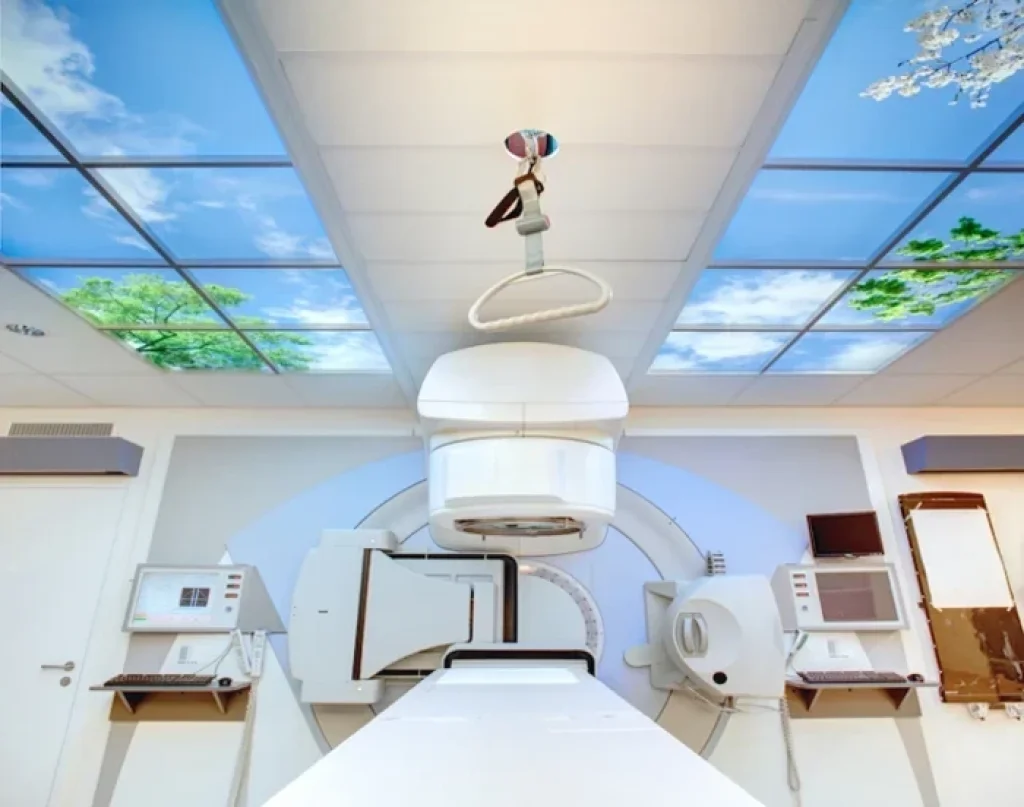
One step further is the LED sky ceiling: a combination of biodynamic LED lighting with a high-quality photographic print that creates the illusion of an opening to the outdoors. The photo, taken with professional cameras with sensors of 45 megapixels or more, shows a clear sky with clouds, a leafy canopy or another natural scene at life size.
Thanks to the smart frame system of OpenCeilings, the illuminated panel sits a few centimetres recessed into the ceiling, which gives a convincing 3D depth effect. Users experience it as a real skylight. It is a proven technique in psychology: visual views outward reduce the feeling of confinement and activate the same relaxation response as a real view of nature.
Want to know more about the available designs? Take a look at our sky ceilings overview on our website.
Where a sky ceiling focuses on the ceiling plane, virtual windows simulate a sideways view, exactly as a real window would. The OpenWindows from OpenCeilings are illuminated photo panels that can be mounted on any wall. Installation is as simple as hanging a painting; no structural work is required.
The images can be swapped per season or theme: a snow-covered mountain landscape in winter, a beach with palm trees in summer. This flexibility makes OpenWindows particularly suitable for environments where variety and atmosphere matter, such as waiting rooms in healthcare settings, hotel lobbies or recreation areas.
The most powerful solution is the combination of all three: biodynamic LED lighting in the ceiling, a sky ceiling for visual openness above, and one or more OpenWindows for the sideways perspective. Together they create an environment that simulates daylight on all sensory levels: light spectrum, light intensity, colour temperature and visual experience.
In healthcare settings we see this combination applied more and more often in treatment rooms, MRI rooms and sensory rooms, where the calming effect of simulated nature contributes to the wellbeing of patients and staff. You can find more about our healthcare applications on the healthcare page of OpenCeilings.
A frequently asked question is whether simulated daylight and photorealistic nature images actually work, or whether they are merely an aesthetic addition. Science gives a clear answer: yes, they work. And they work for a good reason.
Our brain evolved over tens of thousands of years in a world of natural light and views of nature. The neurological processes activated when seeing a sky with clouds or a green landscape are the same whether it is a real view or a high-quality photographic simulation. Scientists call this the biophilic response: the innate tendency of humans to react positively to nature and natural stimuli.
Research in the field of biophilic design consistently shows that people in environments with natural elements or simulated nature have lower cortisol levels, recover faster from stress, report higher satisfaction scores and are more productive. The positive effects are measurable even with photos of nature on the wall. An illuminated photo panel showing a clear sky therefore has a proven therapeutic value that goes beyond decoration.
In healthcare institutions this effect has been studied for decades. Roger Ulrich's classic study showed that patients with a view of trees recovered faster from surgery and needed less pain medication than patients without that view. More recent follow-up studies confirm that simulated nature, such as high-resolution photo panels, also has a significant positive effect on stress levels and perceived comfort.
Biophilic design in practice. Companies that apply biophilic design in their office report on average 15% higher creativity and 6% higher productivity among employees (source: Human Spaces Report). An investment in daylight solutions pays for itself in better performance and less absenteeism.
In modern office buildings, fully interior rooms are the norm. Server rooms, archives and meeting rooms on the inner ring of a floor structurally have no windows. But even open-plan offices with windows on the outer facade have employees who sit deeper in the building and hardly receive any daylight.
Biodynamic lighting in meeting rooms supports concentration levels during long sessions. In the morning, the cool, bright light stimulates alertness; in the afternoon the system switches smoothly to neutral light to limit the post-lunch dip. The result is a room that supports the biology of its users instead of working against it.
In healthcare settings the challenge is twofold: patients are vulnerable and dependent on their environment, while care staff work long shifts, often at night too. Windowless treatment rooms, MRI scanners, waiting rooms and sensory rooms are environments where a lack of daylight has a direct impact on wellbeing and recovery.
A sky ceiling in a treatment room gives patients something calming to look at during a procedure. In sensory rooms, biodynamic lighting helps align the senses with the time of day. And for care staff who work several shifts a week in windowless corridors, a simulated daylight pattern supports the biorhythm and therefore long-term health.
In shops and hospitality venues, light determines the atmosphere and buying behaviour. Shops in shopping centres or basement levels structurally have no daylight, but with the right lighting strategy they can still create an inviting, energetic atmosphere. In hotels, bedrooms without windows or rooms facing north benefit from dynamic light that still gives the guest a sense of the progression of the day.
Classrooms and university lecture halls in inner-ring positions, laboratories and libraries are environments where pupils and students sit for hours. Good daylight lighting supports concentration and reduces the mental fatigue that occurs when working for long periods under static artificial light. This is particularly relevant during periods of intensive study or exams.
A common question about daylight solutions is: what does it cost and does it outweigh the investment? The answer depends on the solution and the application, but there are several cost benefits that make the business case strong.
The LED panels from OpenCeilings consume only 12 Watts per 60 x 60 cm panel. By comparison, a traditional fluorescent fixture of the same size often uses two to three times as much. On an annual basis this delivers significant savings on the energy bill, especially in environments where lighting is on for 10 or more hours a day.
Thanks to the long lifespan of high-quality LED technology, panels rarely need replacing. The photo panels are easy to clean with a dry cloth and the image can be swapped without technical expertise. This makes the Total Cost of Ownership over the lifetime demonstrably lower than with traditional lighting systems.
The soft side of the ROI is perhaps the most powerful: employees who work under better lighting conditions are absent less, perform better and are more satisfied. For organisations with large teams that structurally work in windowless environments, an investment in daylight simulation technology can pay for itself through higher output and reduced sick leave, although this is hard to quantify exactly.
An important practical advantage is that all OpenCeilings solutions are plug-and-play and fit into any standard suspended ceiling. There is no demolition work, no change to the ceiling structure and no lengthy construction period. The panels replace the existing panels in place, which limits installation time to hours instead of days.
Choosing the right daylight solution starts with a good analysis of the space and its users. We always ask three questions up front:
Who stays there and for how long? Short-stay visitor areas (waiting room, lift) call for a different approach than spaces where people work or stay for hours
What is the primary goal? Productivity and concentration require different light settings than rest and recovery
What is the existing ceiling structure? Standard suspended ceilings of 60 x 60 or 120 x 60 are directly suitable; for other situations we are happy to think along
Based on those answers we advise a combination of products and settings. Want to see the possibilities straight away? Visit our design page or request a no-obligation consultation.
Daylight simulation works on two levels. First the spectral level: biodynamic LED panels contain blue-light components that activate the melatonin suppression and serotonin stimulation that real daylight also triggers. Second the visual level: high-resolution photo panels activate the biophilic response in our brain, which measurably reduces stress and increases wellbeing. Both effects are backed by peer-reviewed scientific research.
The LED panels and photo panels from OpenCeilings are designed for standard suspended ceilings with a grid size of 60 x 60 or 120 x 60 centimetres. These are by far the most common sizes in offices, healthcare facilities and hospitality in the Netherlands and Belgium. Our website offers a downloadable checklist that lets you easily check whether your ceiling is suitable. If it is not, please get in touch; in many situations there are alternatives.
A standard 60 x 60 centimetre panel uses only 12 Watts. That is two to three times more efficient than common LED panels of a similar size. Over a year with 2,500 burning hours (about 10 hours per working day) that is 30 kWh per panel, which comes down to a few euros per year per panel in energy costs. In rooms with dozens or hundreds of panels this delivers a significant saving.
Daylight in a windowless room is not a luxury, it is a proven contribution to health, wellbeing and performance. Whether it is an office where employees work eight hours a day, a treatment room where patients need to calm down, or a meeting room where clear decisions are made: the quality of the light makes a measurable difference.
OpenCeilings offers the most complete solution on the market: from biodynamic LED lighting that imitates the day-night rhythm, to photorealistic sky ceilings and virtual windows that bring the feeling of fresh air indoors. All systems are energy efficient, plug-and-play and compatible with standard suspended ceilings.
Want to experience it yourself? Request our free demo case and discover in your own space what biodynamic lighting and a photo ceiling do for the atmosphere and the feeling of openness. Or get in touch for a no-obligation consultation.
Contact OpenCeilings and find out which solution fits your space best.