
Back to the overview
A suspended ceiling (also called a lowered ceiling) is a ceiling that is hung below the existing structural ceiling. It consists of a grid of metal profiles attached to the ceiling, in which loose ceiling tiles (panels) of a standard size lie. Such a suspended ceiling is usually hung with quick hangers, wire hangers or steel cables, which creates a space between the old ceiling and the new one – this space is called the plenum. All kinds of installations can be hidden in the plenum, such as pipes, ventilation ducts and cables. This is immediately one of the biggest practical advantages: all the messy technology above the ceiling is out of sight, but remains accessible by simply lifting a ceiling tile.
The ceiling tiles for suspended ceilings are usually available in two standard sizes: 60×60 cm and 60×120 cm. These modular sizes make designing and installing easy and give the ceiling its characteristic grid pattern. The panels themselves come in various materials (e.g. mineral fiber, plasterboard, metal cassettes) and finishes, but their size always fits such a standard grid. Thanks to this uniformity, finishing contractors and DIYers can easily replace or swap modules – and as we will see later, it also allows innovations such as OpenCeilings to integrate seamlessly into existing ceilings.
There are a number of clear reasons to choose a suspended ceiling:
All installations neatly out of sight: A suspended ceiling creates a hidden space above the ceiling tiles. Ugly cable trays, tubes, pipes or air conditioning installations that would otherwise be visible are neatly concealed. The result is a sleek and tidy ceiling surface. And if something breaks or you need access? Then you can simply take out a tile to get to it, without demolition work. This is ideal in offices or shops, for example, where a lot of technical infrastructure runs above the ceiling.
Good acoustics and insulation: Many suspended ceiling tiles have acoustic properties. They absorb sound in the room, which reduces reverberation and creates a more pleasant acoustic climate – for example in busy open-plan offices or classrooms. At the same time they also offer sound insulation upwards: the plenum and the tiles dampen impact noise to the floors above. You can deliberately choose tiles with high sound absorption (for silence in the room) or sound insulation (to limit noise nuisance upwards). In addition, the space above the ceiling can be used to add extra insulation material for thermal or sound insulation.
Fast and dry installation: Compared to a traditional plastered or lowered plasterboard ceiling, a suspended ceiling is quick and clean to install. No wet plaster or stucco is needed; the profiles are fixed and the panels are laid in, done. This means an enormous time saving. The ceiling tiles are often already finished (white, textured or foiled) and you do not have to paint or spray after installation. An average office space can be given a completely new ceiling in a short time with minimal disruption.
Flexible and accessible: The height of a suspended ceiling is flexibly adjustable. You can hang the ceiling as high or low as needed, for example to keep space above for installations. This makes suspended ceilings suitable for virtually any space, high or low. Moreover, the system remains modularly accessible: each tile can be removed individually for maintenance or replacement. Is a tile damaged or dirty? You simply replace it individually, without having to renew the entire ceiling. Maintenance is therefore easy and repairs can be done locally, which is sustainable and cost-saving.
Integration of lighting and devices: Suspended ceilings are very versatile in building in lighting and other elements. There are custom LED panels of 60×60 that fit exactly in the grid, as well as recessed spots, ventilation grilles, speakers and sprinkler heads that are compatible with suspended ceilings. This allows you to integrate lighting and technology neatly into the ceiling surface without separate constructions. Depending on the function of the room you choose the appropriate fixtures (e.g. large LED panels for a meeting room or atmospheric spots in a reception area). Everything becomes one whole with the ceiling.
Cost-efficient: Both the material and the installation of suspended ceilings are relatively affordable compared to other ceilings. The standard panels are cheap, and the installation time is short (so low labor costs). Especially for large surfaces in commercial construction it is often the most economical ceiling solution. You also save costs indirectly because you can easily change something later without major renovation. In short, for the price per square meter a suspended ceiling is often the smartest choice.
In summary, suspended ceilings offer a combination of functionality, convenience and flexibility that other ceiling systems find hard to match. It is therefore no wonder that you encounter them so often in all kinds of buildings – from office buildings and schools to hospitals and shops. But… there is also a downside to that functionality.
Ask someone for their opinion about suspended ceilings and chances are they will say: “Those white squares? Not very pretty…”. Despite all the practical advantages, suspended ceilings have the reputation of being boring or ugly. Visually they often give a rather cold, businesslike appearance. Everyone knows it: that typical grid ceiling with dull white tiles – fine for an average office space or supermarket, but in a representative entrance hall or modern interior, for example, they can feel soulless.
The cause is clear: suspended ceiling tiles are mainly designed for functionality (absorption, fire safety, price) and less for aesthetics. Standard tiles are usually plain white or gray, sometimes with a simple perforation or grainy structure. The modular grid itself is visible as lines. This leads to a monotonous ceiling surface that contributes little to the look of a space. In creative interiors or architectural showpieces, suspended ceilings are therefore often avoided in favor of more expensive design ceilings or a finish of plasterboard plus paintwork.
Yet suspended ceilings are everywhere, because their advantages simply weigh heavily. How great would it be if we could have the best of both worlds: all the functionality of a suspended ceiling, and an aesthetically attractive design? That is exactly where OpenCeilings comes in.
OpenCeilings is a groundbreaking concept that completely transforms the look of suspended ceilings, without changing the existing structure. The idea is both simple and brilliant: replace some (or all) standard ceiling panels with special LED photo panels with high-resolution images. These panels give the realistic effect of, for example, an open sky or another beautiful scene, thanks to built-in daylight LED lighting. With OpenCeilings you turn a boring ceiling tile into a lifelike skylight! This sky ceiling is also known as a photo ceiling.
How does this work in practice? The OpenCeilings panels fit exactly in a standard 60×60 suspended ceiling grid, including the most common T24 profile width (24 mm). You can therefore swap them one-to-one with the old tiles – ideal for finishing contractors who want to offer something new during renovation without demolishing the whole ceiling. Behind the photo panel sits smart LED lighting that imitates natural daylight. Together with the photo print (think of a blue sky with clouds, a green tree canopy, or any desired image) the illusion of a real window to the outside is created. Small, closed or dark spaces immediately feel much more open and pleasant. People literally experience more “space” and a nicer atmosphere, for example less oppressive in a treatment room or meeting room.
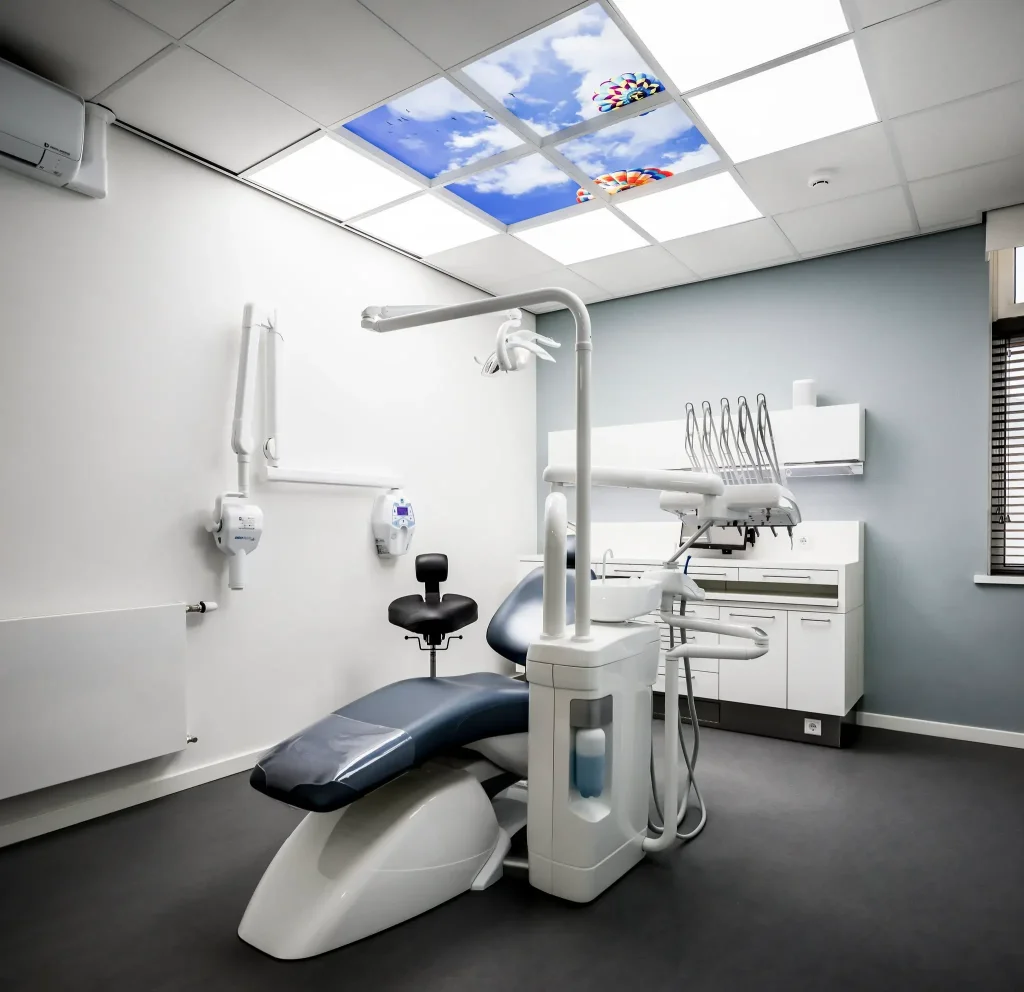
Example: a few OpenCeilings panels with a cloudy sky in a dental practice. They break the monotonous white ceiling and give patients something relaxing to look at.
OpenCeilings thus combines technology and design to make the ceiling an eye-catcher. A few features and advantages of this solution at a glance:
Improved experience: In environments such as hospitals, dental practices or office cubicles, a photo ceiling with a beautiful sky or nature image can improve work and well-being. Instead of looking at boring panels, users get a beautiful view above them. This is not only pleasant for end users (such as patients, customers or employees), but also a big plus for interior architects who want to add experience to a space.
Retaining functionality: Importantly, all the original advantages of the suspended ceiling are retained. The OpenCeilings LED panels are designed to fit in the modular system and are easy to (dis)assemble. They even improve the lighting (through the daylight effect) and can also be acoustically effective. Maintenance of installations above remains possible – the panels can be made accessible just like standard tiles. Finishing contractors hardly have to adapt their installation method, which makes it a practical upgrade.
Creative freedom: OpenCeilings offers various designs and even custom work. Think of a ceiling full of blue sky and clouds, a leaf canopy of trees for a forest feeling, or a starry sky for a relaxation room. Architects and interior designers can thereby make their ceiling design a real part of the interior concept, instead of hiding it. Because the photo panels are interchangeable, you can also switch the atmosphere per season or according to the user’s preference. The ceiling becomes a canvas for creativity, without the need for expensive custom-made ceilings.
Applicable in existing and new ceilings: Whether it concerns the renovation of an old office building or a new-build project, OpenCeilings can be integrated. Existing suspended ceilings (mostly 60x60/T24) can be fitted with these panels afterwards – a relatively small intervention with a big visual impact. New projects can take a certain pattern of photo panels between the regular tiles into account right from the design. The flexibility is enormous; you can create a few accent areas or install a complete photo ceiling.
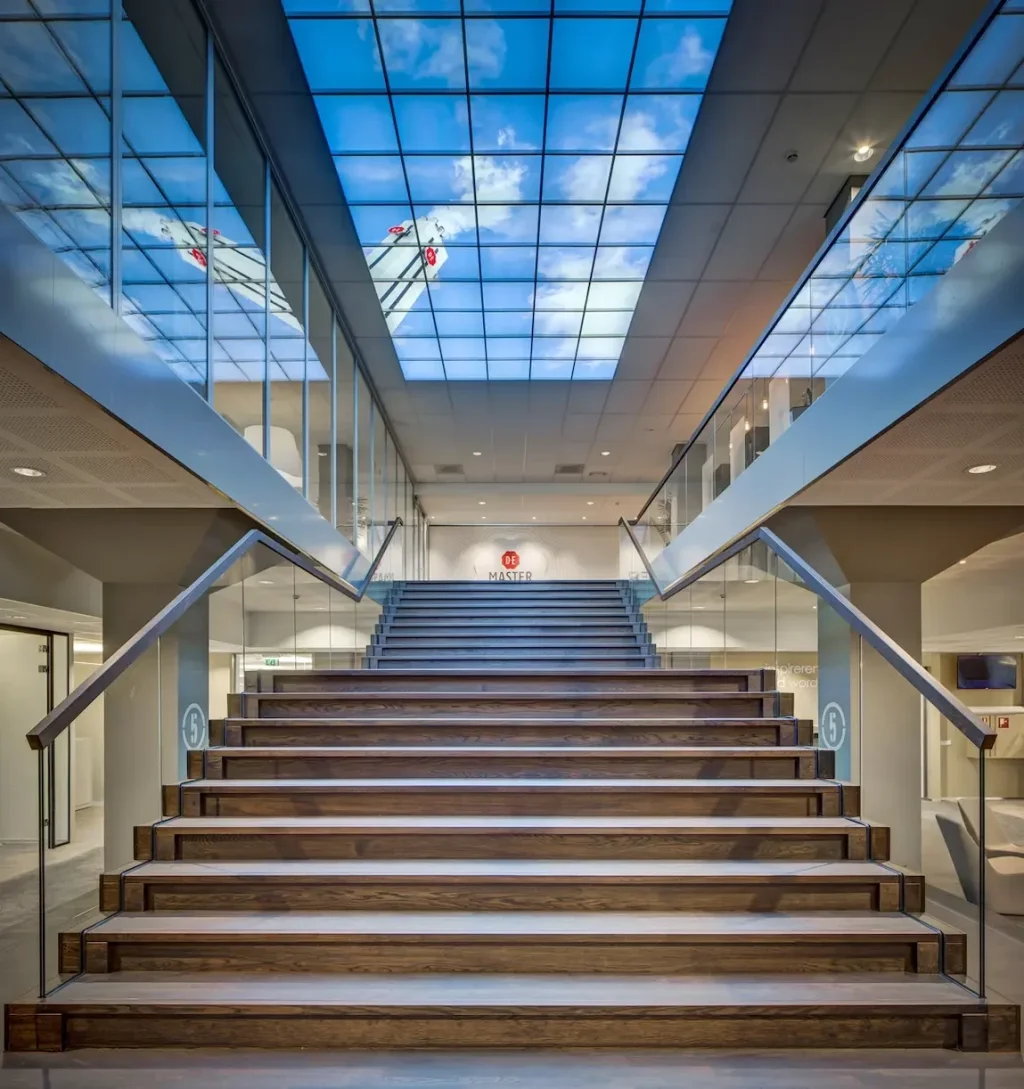
With solutions like OpenCeilings, the old stigma of “suspended ceilings are boring” becomes a thing of the past. End users enjoy the functional advantages (better acoustics, bright space, no visible tangle of cables) and a beautiful ambiance in their room. Architects and interior designers suddenly have a new instrument in hand to make ceilings something unique, without compromising on practical requirements and budgets. And for finishing contractors and ceiling fitters it offers a chance to stand out: they can provide an extra service by not only “neatly closing” a ceiling, but also adding a wow factor to it.
Suspended ceilings thus remain as popular as ever – and rightly so, given all the advantages. But now we no longer have to resign ourselves to a boring sight. Functional and beautiful go hand in hand. OpenCeilings shows that innovation can transform even the most everyday ceiling into an inspiring view. And whoever stays under a beautiful sky ceiling will agree that a good ceiling can work wonders in any space.